Python Tutorials
Now let us deep dive into the basics and components to learn Python Programming:
Welcome to the Python tutorial section! Here, we’ll cover the essential elements you need to kickstart your journey in Python programming. From syntax and keywords to comments, variables, and indentation, we’ll explore the foundational concepts that underpin Python development.
- Learn Python Basics
- Syntax
- Keywords in Python
- Comments in Python
- Learn Python Variables
- Learn Python Data Types
- Indentation and why is it important in Python
In this segment, we delve into the fundamental aspects of handling input and output operations in Python, crucial for interacting with users and processing data effectively. From mastering the versatile print() function to exploring advanced formatting techniques and efficient methods for receiving user input, this section equips you with the necessary skills to harness Python’s power in handling data streams seamlessly.
- Python print() function
- f-string in Python
- Print without newline in Python
- Python | end parameter in print()
- Python | sep parameter in print()
- Python | Output Formatting
- Taking Input in Python
- Taking Multiple Inputs from users in Python
Python offers, enabling you to manipulate and manage data with precision and flexibility. Additionally, we’ll delve into the dynamic world of data conversion with casting, and then move on to explore the versatile collections Python provides, including lists, tuples, sets, dictionaries, and arrays.
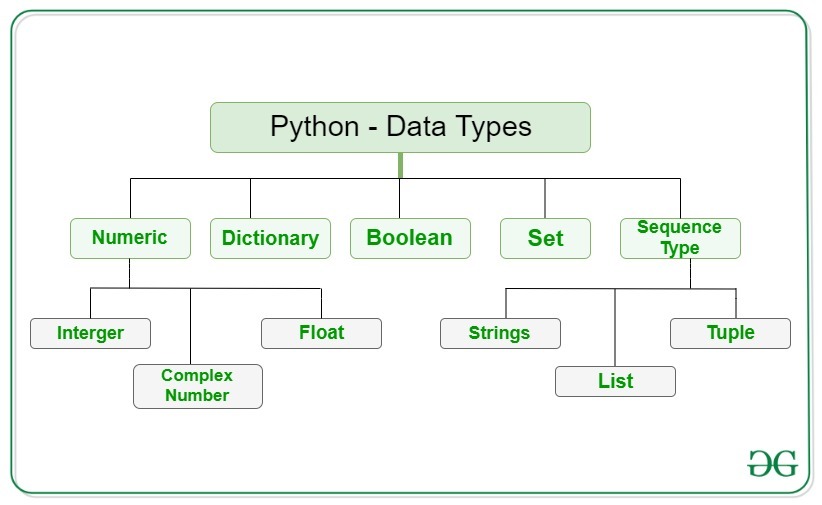
By the end of this section, you’ll not only grasp the essence of Python’s data types but also wield them proficiently to tackle a wide array of programming challenges with confidence.
- Strings
- Numbers
- Booleans
- Python List
- Python Tuples
- Python Sets
- Python Dictionary
- Python Arrays
- Type Casting
From performing basic arithmetic operations to evaluating complex logical expressions, we’ll cover it all. We’ll delve into comparison operators for making decisions based on conditions, and then explore bitwise operators for low-level manipulation of binary data. Additionally, we’ll unravel the intricacies of assignment operators for efficient variable assignment and updating. Lastly, we’ll demystify membership and identity operators, such as in and is, enabling you to test for membership in collections and compare object identities with confidence.
- Arithmetic operators
- Comparison Operators
- Logical Operators
- Bitwise Operators
- Assignment Operators
- Membership & Identity Operators | Python “in”, and “is” operator
These statements are pivotal in programming, enabling dynamic decision-making and code branching. In this section of Python Tutorial, we’ll explore Python’s conditional logic, from basic if…else statements to nested conditions and the concise ternary operator. We’ll also introduce the powerful match case statement, new in Python 3.10. By the end, you’ll master these constructs, empowering you to write clear, efficient code that responds intelligently to various scenarios. Let’s dive in and unlock the potential of Python’s conditional statements.
- Python If else
- Nested if statement
- Python if-elif-else Ladder
- Python If Else on One Line
- Ternary Condition in Python
- Match Case Statement
Here, we’ll explore Python’s loop constructs, including the for and while loops, along with essential loop control statements like break, continue, and pass. Additionally, we’ll uncover the concise elegance of list and dictionary comprehensions for efficient data manipulation. By mastering these loop techniques, you’ll streamline your code for improved readability and performance.
- For Loop
- While Loop
- Loop control statements (break, continue, pass)
- Python List Comprehension
- Python Dictionary Comprehension
Functions are the backbone of organized and efficient code in Python. Here, we’ll explore their syntax, parameter handling, return values, and variable scope. From basic concepts to advanced techniques like closures and decorators. Along the way, we’ll also introduce versatile functions like range(), and powerful tools such as *args and **kwargs for flexible parameter handling. Additionally, we’ll delve into functional programming with map, filter, and lambda functions.
- Python Function syntax
- Arguments and Return Values in Python Function
- Python Function Global and Local Scope Variables
- Use of pass Statement in Function
- Return statemen in Python Function
- Python range() function
- *args and **kwargs in Python Function
- Python closures
- Python ‘Self’ as Default Argument
- Decorators in Python
- Python closures
- Map Function
- Filter Function
- Reduce Function
- Lambda Function
In this segment, we’ll explore the core principles of object-oriented programming (OOP) in Python. From encapsulation to inheritance, polymorphism, abstract classes, and iterators, we’ll cover the essential concepts that empower you to build modular, reusable, and scalable code.
In this section of Python Tutorial, we’ll explore how Python deals with unexpected errors, enabling you to write robust and fault-tolerant code. We’ll cover file handling, including reading from and writing to files, before diving into exception handling with try and except blocks. You’ll also learn about user-defined exceptions and Python’s built-in exception types.
- Python File Handling
- Python Read Files
- Python Write/Create Files
- Exception handling
- User defined Exception
- Built-in Exception
- Try and Except in Python
The biggest strength of Python is a huge collection of standard libraries which can be used for the following:
- Built-in Modules in Python
- Python DSA Libraries
- Machine Learning
- Python GUI Libraries
- Web Scraping Pakages
- Game Development Packages
- Web Frameworks like, Django, Flask
- Image processing (like OpenCV, Pillow)